About Nexus Market
Nexus launched in November 2023 and has grown faster than any market I've tracked in recent memory. In just over two years, this Nexus darknet market has built up close to 40,000 unique product listings and a massive base of registered users. The growth trajectory has been steep, and it hasn't plateaued yet.
What's driving the growth? Two things: the user experience is genuinely good, and the Nexus darknet market security model was built right from day one. Nexus wasn't cobbled together from existing marketplace code — it was built from scratch with modern practices. Enforced PGP encryption, multi-signature escrow, and a vendor verification system that actually weeds out scammers before they get established.
The market supports Bitcoin (BTC), Monero (XMR), and Litecoin (LTC) through a wallet-less payment system. That means no depositing funds into a market wallet — you pay directly when you buy. And there are zero fees for buyers. The market takes its cut from vendors, not from you. That's a meaningful difference when you're comparing platforms. If you need a verified Nexus market link, the onion addresses at the top of this page are PGP-confirmed.
Interface and Design Quality
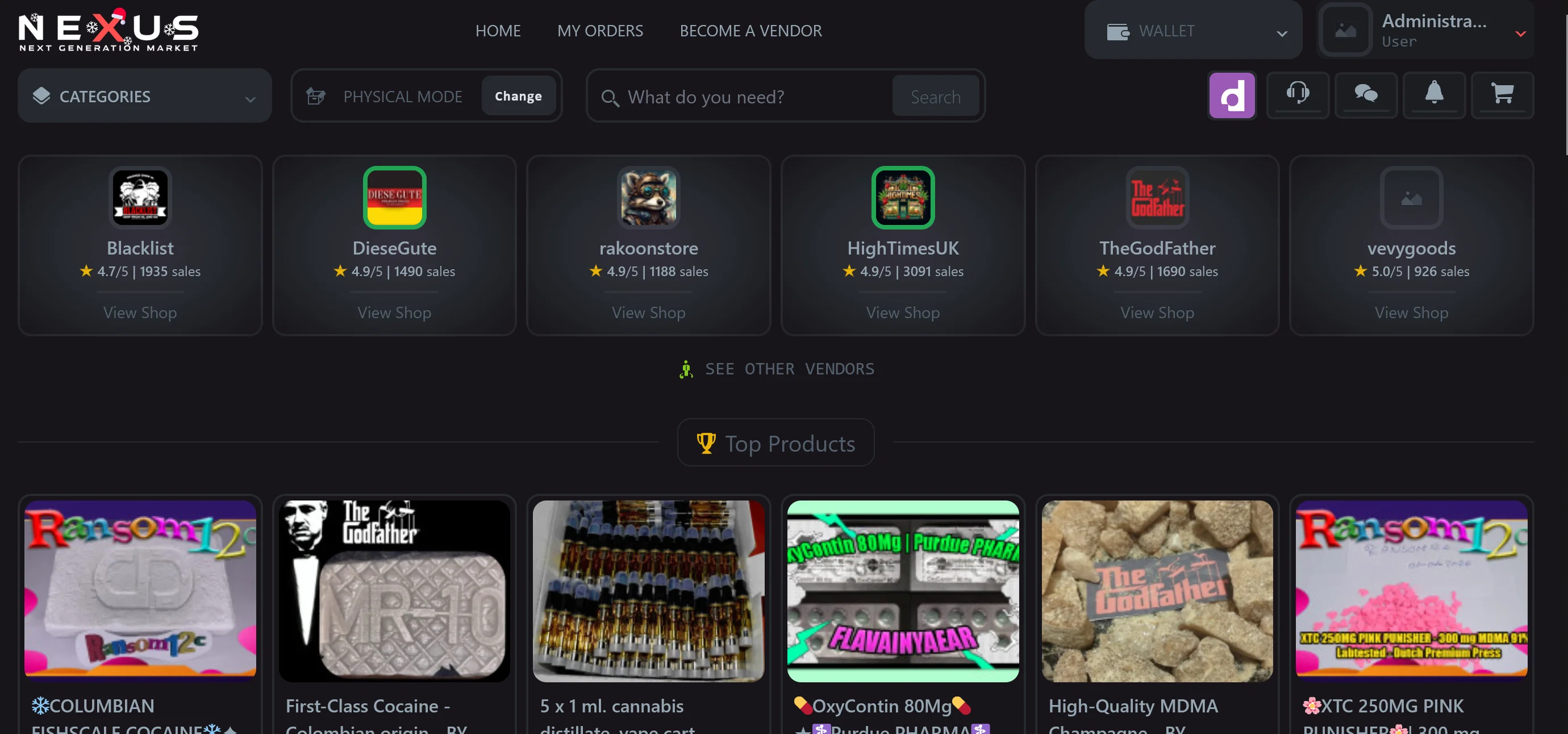
I've used a lot of darknet markets over the years, and Nexus is easily one of the best-looking platforms available right now. That might sound like a minor point, but for a Nexus dark web market, good design actually matters — it makes the difference between a frustrating experience and a usable one.
The interface is minimal without being sparse. Every page includes a dropdown category menu and a persistent search bar, so you're never more than one click away from finding something. The advanced search filters show up automatically when you start a query, letting you narrow by location, price, category, and vendor rating.
One feature that stands out: the physical/digital mode toggle. From the home screen, you can switch between physical product categories and digital product categories. Instead of scrolling through a mixed list of drugs and software and fraud materials, you see only what's relevant. It sounds simple, but nobody else does this — and it makes navigation significantly cleaner.
The design is consistent across every page. Product listings, vendor profiles, order management, dispute resolution — everything follows the same visual language. There's no jarring style shift when you move between sections, which is more common on other markets than you'd think.
Wallet-less Payments and Zero Buyer Fees
Nexus uses a wallet-less payment system. When you make a purchase, you send crypto directly to an escrow address tied to that specific order. No market wallet to deposit into, no balance sitting on someone else's servers waiting to be stolen in an exit scam or seized in a raid.
This model has real security advantages. Markets that hold hundreds of thousands of dollars in user deposits are sitting on a massive incentive to exit scam. With wallet-less payments, the amount of user funds the market holds at any given time is limited to active escrow transactions.
Nexus supports three cryptocurrencies: Bitcoin, Monero, and Litecoin. For privacy, Monero is the strongest choice. For convenience, BTC and LTC give you options. Some vendors specify their preferred currency, but most accept all three.
Zero fees for buyers is the other significant detail. Every fee — marketplace commission, transaction processing — is absorbed by the vendor. As a buyer, the price you see is the price you pay. No hidden surcharges, no deposit fees, no withdrawal fees. Most markets charge somewhere between 2-5% to buyers on top of the listing price. Nexus doesn't.
Nexus Market Security
Nexus was built with security baked in from the architecture level, not bolted on after the fact. Here's what that looks like in practice:
Enforced PGP encryption. Not optional, not "recommended." All sensitive communications — especially shipping addresses — must be PGP encrypted. Nexus enforces this at the platform level, which means even careless users are protected by default.
Multi-signature escrow. Available across this Nexus darknet market. Multisig means the market alone cannot release or steal funds — two of three key holders (buyer, vendor, market) must agree on a release. This is the strongest escrow model available on any darknet market.
Vendor verification system. New vendors go through a verification process before they can list products. This doesn't eliminate all scammers, but it creates a significant barrier that random fraudsters can't easily clear. The result is a vendor base that's noticeably more reliable than markets with lax onboarding.
Community trust model. Nexus has built its reputation partly through transparency and fair dispute resolution. The market actively communicates with users about changes, downtime, and security incidents. That level of openness is unusual and builds the kind of trust that keeps users coming back.
Product Range and Market Scale
With close to 40,000 unique listings, Nexus is one of the largest markets currently operating. The product range spans the standard categories — drugs across all subcategories, digital goods, fraud materials, services, and more. International shipping is available for most physical products, and the vendor base covers multiple regions worldwide.
The physical/digital mode separation means you can focus your browsing. If you're only interested in digital products, switch to digital mode and the entire navigation adjusts — no physical product categories cluttering your view. Vice versa for physical goods. This level of interface thought is rare on darknet markets.
Vendor quality on the Nexus darknet market tends to be high. The verification process filters out low-effort sellers, and the community actively polices quality through the rating system. Vendors with established reputations from other markets often bring their verified track records with them when they start listing on Nexus. If any Nexus mirror goes down, check the backup addresses at the top of this page — all are PGP-verified.
Verifying Nexus Links — Why Speed of Growth Increases Risk
Nexus faces a verification challenge that slower-growing markets don't: its rapid rise has made it one of the most heavily phished platforms on the dark web. At any given time, multiple convincing Nexus clones are active — some with pixel-perfect reproductions of the real interface. The design quality that makes real Nexus stand out also makes it easier for phishers to create believable fakes.
The verification process matters more here than on a market like DarkMatter, where phishing attempts tend to be cruder and less frequent. With Nexus, you need to be especially rigorous:
- Get Nexus's PGP public key from Dread — and save a local copy with the fingerprint noted separately
- Check the latest signed canary from the Nexus team. Canaries are posted on their subdread
- Verify the PGP signature. If valid, the addresses in the canary are confirmed
- Do not trust bookmarks blindly — re-verify after any period of not accessing the market
Unlike DrugHub (which generates unique per-visitor links) or TorZon (which has a personal phrase system), Nexus uses static onion addresses with no secondary on-site verification layer. This means PGP canary verification is your only reliable protection for every Nexus mirror and Nexus link you use. Don't skip it — the quality of Nexus phishing clones makes visual inspection worthless.
The addresses at the top of this page are cross-referenced with the latest signed canary. But independent verification is always recommended. The entire point of PGP is that you don't need to trust anyone else — including this directory.
Nexus Market Mirrors
Nexus runs three onion mirrors — a primary and two backups. All three Nexus onion link addresses are verified together through PGP-signed canary statements. If the primary Nexus link goes down during a DDoS or rotation, the mirrors keep access available. As with every market on this list, never trust a Nexus mirror from an unverified source.
Nexus Market — Pros and Cons
Strengths
- Zero buyer fees — vendor-absorbed commissions
- Wallet-less payments — minimal exit scam exposure
- Multi-signature escrow — strongest fund protection model
- Best interface design on the dark web
- Physical/digital mode toggle — cleaner browsing
- Enforced PGP encryption at platform level
- Three crypto options (BTC, XMR, LTC)
Weaknesses
- Relatively new (Nov 2023) — shorter operational track record than DarkMatter
- Heavy phishing target — multiple convincing clones active
- No on-site phishing protection (no personal phrase, no unique links)
- BTC accepted — users may choose less private option by convenience
Nexus Market — Frequently Asked Questions
Is Nexus Market still active in 2026?
Yes. Nexus has been running continuously since November 2023 and is currently the fastest-growing darknet market. With close to 40,000 active listings and a rapidly expanding user base, it shows no signs of declining. Regular address rotations occur as standard operational security.
What is the current Nexus market link?
The current verified Nexus link and onion addresses are at the top of this page — one primary and two mirrors. All have been confirmed through PGP signature validation. Always verify independently through signed canary statements before connecting.
Does Nexus charge fees to buyers?
No. Nexus operates a zero-fee model for buyers. All marketplace commissions are paid by vendors. The price listed on a product is the exact amount you pay — no hidden charges, deposit fees, or transaction surcharges. This is distinctive among darknet markets, most of which charge buyers 2-5% per transaction.
What payment methods does Nexus accept?
Nexus supports Bitcoin (BTC), Monero (XMR), and Litecoin (LTC) through a wallet-less payment system. You pay directly per order rather than depositing funds into a market wallet. Monero provides the strongest transaction privacy, but all three currencies are accepted by most vendors.